Writing sample
Mourning without Answer: Deaths of Chicago Trans Women Leave Questions Unanswered

A funeral will be held for Elise Malary on May 5, about 50 days after she died of an unknown cause. Within 24 hours of Malary’s body being found on the shoreline of Lake Michigan on March 17, the search for Tatiana “TeTe” Labelle ended 21 miles south, in an alley in the East Chatham neighborhood, where her body had been discarded in a garbage can. While the manner of their deaths may differ, their occurrence continues a pattern of premature death among Trans people.
The epidemic of Trans violence is not news. Since 2013, the Human Rights Campaign has tracked 256 known cases of fatal violence against Trans and gender-nonconforming people in the United States. The organization publishes its Epidemic of Violence report each year, detailing these findings. According to HRC, 71% of victims are under the age of 35, and 66% were Black women.
According to data provided by the 2015 Trans US Trans Survey, the clearance rate of these cases is 40%.
The Transgender Day of Remembrance organization tracks Trans fatalities as well. Though their count is higher than HRC, TDoR’s tracking criteria include suicide and uncategorized deaths, believing these also result from Transphobia in society.
According to TDoR, each year since 2014, these reports have risen. 2021 marked the deadliest year for Trans people in the United States, with 77 recorded fatalities, 6 occurring in Chicago and its surrounding suburbs. And 4 were homicides, which remain open. In 2022, the current total is 16, including 2 Chicagoans, Elise Malary and Tatiana Labelle.
Elise Malary was acutely aware of the probability of violence that loomed around her and her community. According to those who knew her through her work as an activist and organizer, she persistently, kindly, and fiercely advocated for the betterment of Trans Black femme experiences. She worked as an administrative clerk in the Illinois Attorney General’s Office, until March 9, when her supervisor received an email notifying the office of her resignation. This same day, Malary’s sister received the last known contact that any of her loved ones got.
The last text message that Fabiana Malary received from her sister said, “I’m going to pay it sis.”
Elise Malary had been providing financial support to her family following the recent death of their father. After not hearing back from her sister for two days, Fabiana filed a missing person’s report. Upon investigating her apartment, Evanston police reported both her front and back doors had been left unlocked. Malary’s loved ones said this was uncharacteristic of her; however, police noted no signs of foul play. On March 15, her car was found unlocked nearby.
On Thursday the 17th, following a tip that Malary had been seen with two men near the redline station in Rogers Park, Chicago Therapy Collective rallied the Trans community for a search party in Rogers Park. As volunteers handed out their last fliers at 4:30 p.m., a mile and a half away, the body of a Black woman was found on the beach near Garden Park in Evanston. Following identification by Malary’s sister, her death was publicly announced on March 19. As the community scoured for and came to mourn her, all the while, another search was underway on the South Side.
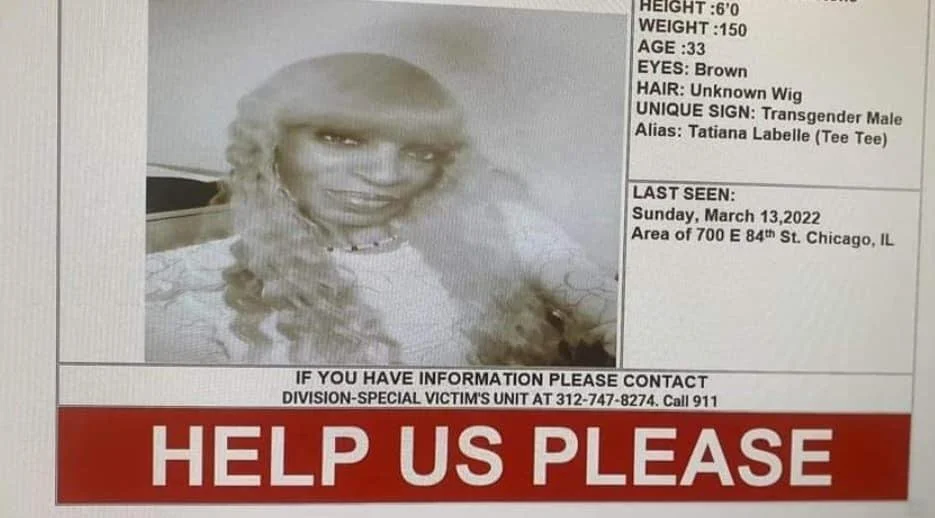
According to a CPD report, an on-scene witness discovered the body of an unknown woman had been found in a garbage can. On March 19, an autopsy report by Cook County Medical Examiner’s office ruled the death a homicide, and Shameka Thomas identified the victim as her sibling. Although Tatiana Labelle was, in fact, the sister of Thomas, both Chicago Police reports and Cook County Medical Examiner documentation misgendered and deadnamed her, meaning that she was referred to as her given name, rather than her chosen one.
On April 4, Labelle’s family held a funeral. The brochure memorialized Labelle with an image of her, pre-transition and used her dead name. Family members wore T-shirts with similar imagery.
“It’s the ultimate sign of disrespect,” says Alexis Martinez, a friend and colleague to Malary and a Court Specialist for the Transformative Justice Law Project. She believes that every Trans person should prepare a final will, in order to ensure that their wishes are respected after death. “Elise has a whole community to speak for her,” said Martinez. In the wake of Labelle’s death, she did not believe that to be the case.
Although not uncomplicated, the family of Labelle was undoubtedly grief-stricken. Following Labelle’s gruesome death, her mother, Tammy Whetstone, drove from her home in Kalamazoo, Michigan.
“We saw Tete, we loved [deadname redacted],” Whetstone says that Labelle had come out as Transgender around 3 to 4 years prior to her death. Her mother says that she was happier and didn’t have to hide anymore.
Before the family reported her missing on March 13, Labelle had been staying with her grandmother. According to Whetstone, Labelle was recently kicked out due to drug use. After her murder, the first update family received wasn’t from Chicago Police. Instead, it was a Facebook photo of her death in a trash can. Immediate news coverage followed the lead of police reports and medical examiner documents, continuing to misgender and use her given name. Although Malary was never misgendered by police or the press covering her death and disappearance, this is not the case for most Trans fatalities.
According to the LGBT+ Accountability for Missing and Murdered Persons (LAMMP), misgendering and deadnaming of victims impedes the integrity of investigations.

One instance of this is 19-year-old Koko Nia Labeija, who died in June of 2020, but remained unidentified until April 2021, when LAMMP aided CPD in identifying the victim after CPD had failed to identify her for nearly a year.
Beyond how their stories were initially represented in the media, coverage of Malary was highly saturated, while Labelle’s death received significantly less coverage.
“News is news for two days,” Whetstone says. But, as press coverage has come to a lull, she feels that Labelle’s case is being forgotten, and the family has received few updates from the police.
“If we don’t call them, they don’t call us,” Whetstone said of the police. “I don’t think they investigate Transgender deaths. They don’t seem to care. Just another dead homo.” She believes that CPD has access to the information needed to find her child’s killer, but resources are not being exhausted.
“Our detectives investigate all homicide cases thoroughly,” said Margaret Huynh, CPD’s Public Relations Coordinator. In addition, the departmental policy outlines specific guidelines for interactions with Trans and gender-nonconforming individuals, which require interviews with family and friends to learn more about victims.
Pending a toxicology report that may take up to 90 days, Elise Malary’s family is likely to bury her without knowing the cause of her death. Throughout Evanston Police Department’s investigation, Commander Ryan Glew has stated no signs of foul play. Angelina Nordstrom says that Malary was their best friend, and they don’t believe that Malary would have harmed herself.
In their grief, the people who loved Elise Malary and Tatiana Labelle still await answers, however unlikely they may be to come.